
Hydroponic Sponge Growing Media: Benefits, Applications and Growing Tips

Hydroponic Sponge Growing Media: Benefits, Applications and Growing Tips
Hydroponic sponge growing media is an alternative to traditional substrates for seed germination, plant propagation, leafy vegetable production and vertical farming. Its lightweight structure, water-holding capacity and flexible design make it suitable for a wide range of soilless cultivation systems.
As commercial hydroponic farming and indoor agriculture continue to develop, growers are looking for growing media that are easy to handle, compatible with irrigation systems and suitable for consistent plant production. Hydroponic growing sponges can be used in seedling trays, NFT hydroponic systems and selected vertical growing applications when the material properties match the crop’s requirements.
In this guide, we explain how sponge growing media work, their main advantages, common applications and the factors to consider when choosing a suitable product for your growing operation.
What Is Hydroponic Sponge Growing Media?
Hydroponic sponge growing media is a porous material used to support seeds, seedlings and plant roots in soilless cultivation. Unlike conventional soil, it provides a lightweight growing structure that can retain moisture while allowing air to move through its pores.
When used with an appropriate nutrient solution and irrigation schedule, a hydroponic growing sponge can help maintain the moisture conditions required for germination and early root development.
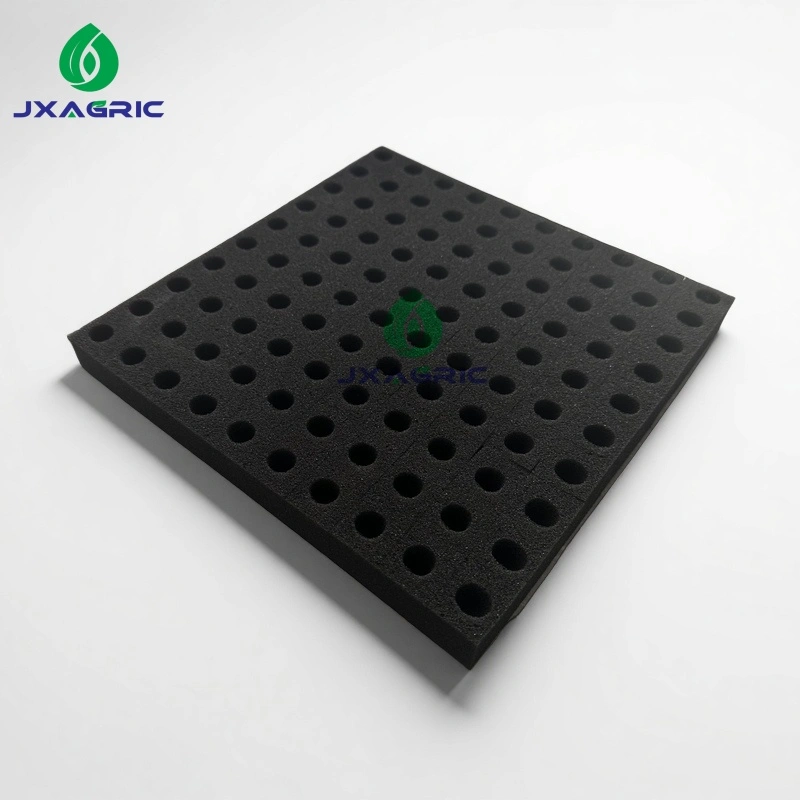
Sponge growing media are available in different shapes, sizes, densities and thicknesses. Depending on the material formulation and intended application, they can be supplied as small propagation plugs, square cubes, strips or larger sheets.
Common applications include:
- Seed germination and seedling propagation
- Lettuce, basil and other leafy vegetable production
- NFT hydroponic systems and compatible growing channels
- Greenhouse vegetable production
- Indoor vertical farming
- Microgreen and ornamental plant propagation
The appropriate sponge specification depends on the crop, growing system, irrigation method and expected production cycle.
How Does Sponge Cultivation Technology Work?
Sponge cultivation is a form of soilless growing in which a porous sponge material supports the plant while water and dissolved nutrients are supplied through an irrigation or nutrient delivery system.
The process generally involves four steps.
1. Seed Germination
Seeds are placed into suitable sponge plugs or cubes. The material is moistened to create conditions that support germination. Moisture levels should be controlled to prevent the growing medium from becoming excessively wet.
2. Root Development
As seedlings develop, their roots grow into the porous structure of the sponge. The balance between water retention and air availability is important for healthy root development.
3. Nutrient Supply
Water and nutrients are delivered according to the crop’s requirements. Depending on the system design, this may involve periodic irrigation, drip irrigation or recirculating nutrient solution.
4. Transplanting or Continued Production
Seedlings can be transferred to compatible hydroponic channels, growing beds or other production systems. Some sponge formats are designed to remain around the roots during the growing cycle, reducing unnecessary root disturbance during transplanting.
Successful sponge cultivation depends on more than the growing medium alone. Nutrient concentration, pH, irrigation frequency, temperature, lighting and crop management must also be considered.
Key Benefits of Hydroponic Sponge Growing Media
1. Lightweight and Easy to Handle
Compared with many mineral-based substrates, lightweight sponge products can simplify transportation, handling and installation.
Their low weight can also be beneficial in indoor growing facilities, propagation areas and selected vertical farming structures where the total load of growing media is an important design consideration.
2. Water Retention and Air Availability
A suitable sponge structure can absorb and retain water while maintaining air-filled pores. This combination helps provide moisture and oxygen around developing roots.
Actual performance varies according to sponge density, pore structure, thickness and material composition. Growers should evaluate water retention and drainage under their own irrigation conditions before selecting a product for large-scale production.
3. Flexible Shapes and Sizes
Sponge growing media can be manufactured in different dimensions to match specific crops and cultivation equipment.
For example, small cubes may be used for seed starting, while strips or larger sheets may be suitable for specialized growing beds. Custom dimensions can also help improve compatibility with automated seeding, transplanting and production lines.
Before ordering customized products, confirm the required dimensions, tolerances, planting-hole specifications and compatibility with existing equipment.
4. Convenient for Seedling Propagation
Hydroponic sponge plugs provide a defined space for seed placement and early root growth. Uniformly sized plugs can simplify seedling management and help growers organize production batches.
For commercial nurseries, product consistency is especially important. Differences in moisture retention, density and dimensions can affect irrigation management and seedling uniformity.
5. Suitable for Space-Efficient Growing Systems
Because sponge growing media are lightweight and available in different formats, they can be incorporated into selected multi-layer cultivation systems and vertical farming projects.
Their suitability depends on the structural design, lighting arrangement, irrigation system and the mature size of the crop. Sponge alone does not determine growing density or yield; the entire production system must be properly designed.
6. Potential to Improve Material and Labor Efficiency
Standardized sponge plugs and cubes may simplify handling, transplanting and routine growing operations. In suitable applications, these characteristics can contribute to more efficient production workflows.
However, overall savings depend on the initial material cost, product durability, irrigation requirements, labor practices and disposal arrangements. Commercial growers should compare total operating costs rather than evaluating the price of the growing medium alone.
Hydroponic Sponge vs. Rockwool: Which Is Better?
Hydroponic sponge and rockwool are both used in soilless cultivation, but they differ in material properties, handling characteristics and disposal requirements.
| Comparison Factor | Hydroponic Sponge | Rockwool |
|---|---|---|
| Weight | Generally lightweight, depending on density | Typically lightweight, depending on format |
| Water retention | Depends on pore structure and formulation | Depends on product grade and structure |
| Air availability | Depends on sponge density and porosity | Depends on product density and irrigation management |
| Available formats | Plugs, cubes, strips and custom shapes | Cubes, slabs and other commercial formats |
| System compatibility | Must match the crop and irrigation design | Commonly used in established commercial systems |
| Reuse potential | Depends on material durability, sanitation and crop requirements | Depends on the product and production protocol |
| End-of-life handling | Depends on the material composition and local disposal options | Used rockwool may require specialized disposal arrangements |
Which Growing Medium Should You Choose?
Sponge may be worth evaluating when lightweight handling, customized dimensions and convenient propagation formats are priorities.
Rockwool may be preferable when a grower already has an established production process designed around specific rockwool products.
Neither material is automatically superior in every growing environment. Before making a large purchase, compare moisture retention, drainage, root development, crop performance, durability and total cost under similar growing conditions.
Also, do not assume that every sponge is biodegradable or suitable for repeated use. These properties must be confirmed for the specific material being purchased.
Applications of Sponge Growing Media in Modern Agriculture
1. Seed Starting and Plant Propagation
Sponge plugs and cubes can be used to germinate seeds and produce seedlings for transplanting. Common applications include lettuce, herbs, leafy vegetables and other crops suitable for the selected growing format.
Consistent dimensions and appropriate moisture management are important for commercial propagation operations.
2. NFT Hydroponic Systems
In NFT hydroponic production, seedlings are typically transferred into net pots or compatible supports positioned in growing channels.
Sponge plugs can help support young plants during establishment. The plug dimensions must match the net pot, planting opening and root-zone requirements.
For commercial lettuce production, it is important to coordinate sponge specifications with channel dimensions, planting spacing and nutrient solution flow.
3. Greenhouse Vegetable Production
Sponge growing media may be evaluated for greenhouse propagation and selected production systems. Their performance depends on crop type, irrigation design and the material’s ability to maintain an appropriate balance of moisture and air.
For fruiting crops such as tomatoes and peppers, growers should verify that the sponge can provide suitable root support throughout the intended production cycle.
4. Indoor Vertical Farming
Vertical farms often require growing media that are easy to position and compatible with multi-layer cultivation equipment.
Lightweight sponge formats can be useful in propagation racks and selected vertical production systems. However, lighting, airflow, humidity control, drainage and irrigation uniformity remain essential to achieving consistent results.
5. Microgreens and Specialized Plant Production
Certain sponge products may be suitable for microgreens, ornamental plants and other specialized cultivation applications.
The material must match the crop’s germination and harvesting requirements. For microgreens, for example, the grower should assess moisture management, root anchoring, harvesting practices and food-safety requirements.
How to Choose the Right Hydroponic Growing Sponge
Selecting a suitable sponge is essential for reliable cultivation. Consider the following factors before placing an order.
Sponge Density and Porosity
Density influences weight, water retention and the physical structure of the material. A sponge that is too dense or poorly aerated may not provide the desired root-zone conditions.
Ask the supplier for relevant specifications and, where possible, test samples under your actual irrigation conditions.
Size, Shape and Thickness
Different crops and production systems require different formats.
- Small cubes or plugs: seed germination and seedling propagation.
- Strips: selected planting channels and specialized cultivation systems.
- Larger sheets: applications requiring a continuous growing surface.
- Custom shapes: equipment-specific or project-based growing applications.
These are general examples rather than universal specifications. Final dimensions should be determined by the growing system and crop requirements.
Water Absorption and Drainage
Good growing media should retain sufficient moisture without remaining excessively saturated.
Request technical information about water absorption, drainage and relevant physical properties. A practical trial can help determine whether the material works with your irrigation schedule.
Material Safety and Consistency
For crops intended for human consumption, material selection should take account of the intended use and applicable food-contact or agricultural requirements.
Ask for material declarations, relevant test reports and quality-control information where applicable. Avoid assuming that a product is food-safe, biodegradable or chemically inert unless its properties have been verified.
Durability, Sanitation and Reuse
Reuse may be possible for certain sponge materials, but it should not be assumed for every product or crop.
Evaluate physical deterioration, root residue, sanitation procedures, disease risks and manufacturer recommendations. Single-use formats may be more appropriate in some commercial propagation operations.
Best Practices for Successful Sponge Cultivation
To achieve consistent results, combine suitable growing media with a well-managed cultivation system.
- Pre-moisten the sponge appropriately. Follow the manufacturer’s recommendations and avoid excessive saturation.
- Maintain a suitable nutrient solution. Monitor pH, electrical conductivity (EC) and nutrient concentration according to crop requirements.
- Manage irrigation carefully. Adjust irrigation frequency to the sponge’s moisture retention, drainage characteristics and environmental conditions.
- Provide adequate lighting and airflow. Maintain conditions appropriate for the crop and growth stage.
- Inspect root health regularly. Check for excessive moisture, poor drainage, discoloration and other signs of root stress.
- Maintain sanitation. Clean reusable equipment and follow appropriate hygiene procedures to reduce contamination risks.
- Conduct a small-scale trial. Test germination, seedling uniformity, root development and handling performance before scaling up.
These practices help growers evaluate whether a specific sponge product is suitable for their production environment.
Is Hydroponic Sponge Growing Media Environmentally Friendly?
The environmental impact of hydroponic sponge growing media depends on the material used, manufacturing process, service life and end-of-life treatment.
Lightweight products may reduce transportation and handling burdens in some situations. Durable products that can be safely reused may also reduce material consumption per growing cycle.
However, not all sponge materials are biodegradable, recyclable or suitable for repeated use. Plastic-based materials, in particular, may require dedicated collection or disposal arrangements.
For a more accurate environmental assessment, growers should ask suppliers about material composition, reuse recommendations, disposal options and supporting documentation. Water and fertilizer savings should also be measured under actual operating conditions rather than assumed.
Frequently Asked Questions About Hydroponic Sponge Growing Media
Can sponge replace rockwool in hydroponics?
Sponge can be an alternative to rockwool in selected applications, particularly seed starting and propagation. Full replacement in commercial production should be based on comparative trials, root-zone performance, crop requirements and system compatibility.
Is hydroponic sponge suitable for lettuce?
Certain sponge plugs and cubes are suitable for lettuce germination and seedling production. They can also be incorporated into compatible NFT systems. The correct size, moisture retention and irrigation management are important for successful establishment.
Can hydroponic sponge be reused?
Reuse depends on the sponge material, durability, sanitation protocol and crop requirements. Confirm the manufacturer’s recommendations and assess the risks of root residue and disease transmission before reuse.
Is hydroponic sponge biodegradable?
Not all hydroponic sponges are biodegradable. Biodegradability depends on the actual material composition and the conditions required for decomposition. Request supporting documentation before making environmental claims.
How do I choose the correct sponge size?
Consider seed size, crop type, root development, net pot dimensions, planting-hole diameter and the intended cultivation system. For commercial projects, testing samples before bulk production can help confirm compatibility.
Can I order customized hydroponic sponge plugs or cubes?
Customization may be available depending on the supplier’s manufacturing capabilities and minimum order quantity. Confirm dimensions, density, thickness, packaging and intended application before ordering.
Conclusion: Find the Right Growing Media for Your Hydroponic System
Hydroponic sponge growing media offers a flexible option for seed starting, plant propagation and selected soilless cultivation applications. Its potential advantages include lightweight handling, customizable formats and compatibility with a range of hydroponic production systems.
The best results depend on choosing the right material and integrating it with suitable irrigation, nutrient management, lighting and crop-care practices.
If you are developing a commercial hydroponic farm, greenhouse or vertical growing project, evaluate the growing medium as part of the complete production system rather than as an isolated product.
Looking for hydroponic sponge growing media for your project? Contact JXAGRIC to discuss your crop requirements, preferred dimensions and growing system. Our team can help you evaluate suitable growing media and compatible hydroponic solutions for your application.
Related product:
Views: 0