
Ebb and Flow Hydroponic System: Benefits, Design and Growing Guide

Ebb and Flow Hydroponic System: Benefits, Design and Growing Guide
An ebb and flow hydroponic system, also known as a flood and drain hydroponic system, is a cultivation method that periodically floods plant roots with nutrient solution and then drains the solution back into a reservoir. This cycle supplies plants with water and nutrients while allowing the root zone to receive oxygen between irrigation cycles.
Also called tidal cultivation, this growing method is widely applicable to greenhouse production, indoor farming, nursery operations, and commercial vegetable cultivation. With a properly designed irrigation system, suitable growing media, and appropriate nutrient management, ebb and flow hydroponics can support efficient water use, flexible crop production, and convenient farm management.
In this guide, we explain how an ebb and flow hydroponic system works, how to design its main components, which crops are suitable, and what growers should consider when planning a commercial cultivation project.
1. What Is an Ebb and Flow Hydroponic System?
An ebb and flow hydroponic system works by repeatedly flooding the growing area with nutrient-rich water and allowing the solution to drain back into a central reservoir. During flooding, plant roots absorb water and essential nutrients. After drainage, air can enter the root zone and replenish oxygen.
Unlike traditional soil cultivation, this method allows growers to control irrigation frequency, flooding duration, and nutrient delivery according to crop requirements and environmental conditions.
The main components of an ebb and flow hydroponic system include:
- Nutrient reservoir: Stores the nutrient solution for circulation.
- Water pump: Delivers nutrient solution to the growing troughs or trays.
- Growing troughs or flood tables: Hold the plants and growing media.
- Inlet and drainage pipes: Distribute and return the nutrient solution.
- Timer or intelligent controller: Controls the irrigation cycle.
- Growing media: Supports plant roots and helps retain moisture and air.
A properly configured system can be used for leafy vegetables, herbs, seedlings, and other suitable crops. Its performance depends on system design, crop selection, water quality, and cultivation management.
2. How to Design an Ebb and Flow Hydroponic System
2.1 Nutrient Reservoir Design
The nutrient reservoir is the central component of an ebb and flow hydroponic system. It stores the nutrient solution and supplies the pump during each irrigation cycle.
Reservoir capacity should be determined according to the total growing area, the volume of solution required to flood the growing troughs, crop water consumption, and the need to maintain a stable solution level.
As an initial reference, a reservoir capacity of approximately 60–75 tonnes per hectare may be considered for preliminary planning. However, this is not a universal specification. The final capacity should be calculated from the actual system layout, operating water volume, and project requirements.
A water pump is installed in or connected to the reservoir and linked to the water inlet pipeline. During irrigation, the pump delivers nutrient solution to the growing area. After flooding, the solution drains back through the return pipes for reuse.
An automatic timer or intelligent control unit can manage pump operation and help maintain a consistent irrigation schedule.
For commercial projects, growers should also consider reservoir accessibility, filtration, cleaning, water-level monitoring, and the control of nutrient concentration and pH.
2.2 Cultivation Trough and Flood Table Design
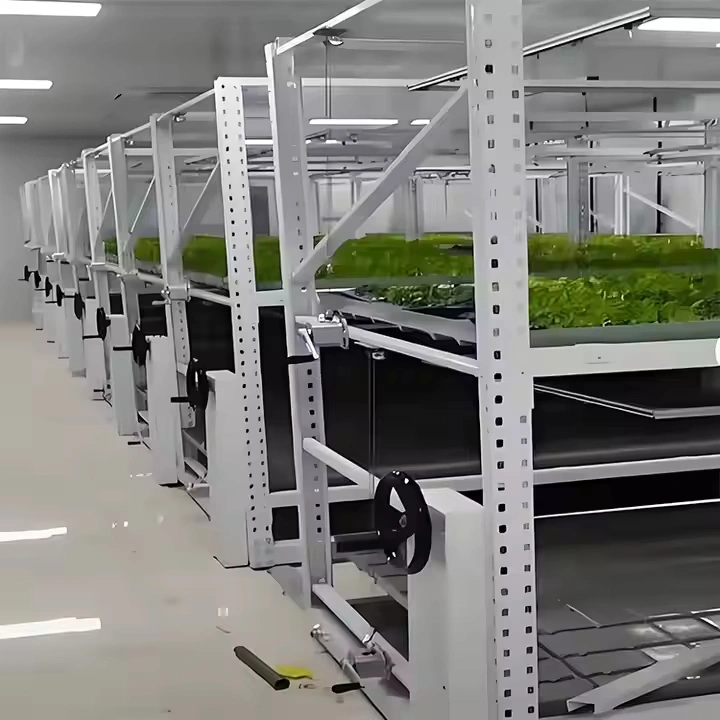
Growing troughs and flood tables can be manufactured in different sizes and configurations to suit the available space, crop type, and production capacity.
For one traditional tidal cultivation layout, the reference dimensions are approximately:
- Trough width: 1.0–1.2 m
- Trough depth: Approximately 20 cm
- Growing media layer: Approximately 3 cm of hydroponic sponge, where suitable
- Irrigation arrangement: Water inlet at one end and drainage outlet at the other
These dimensions are examples rather than fixed requirements. Commercial systems may use different trough depths, widths, lengths, and materials depending on the project.
The trough bottom should provide suitable drainage so that the nutrient solution can return to the reservoir without leaving unwanted standing water. The growing surface should also support uniform flooding and drainage across the cultivation area.
Where a light-excluding cover is used, its purpose is to reduce light exposure to the root zone and limit algae growth. The cover should not prevent adequate air exchange or create excessive heat around the plants.
For commercial greenhouse projects, the growing structure, drainage slope, pump capacity, and pipe layout should be designed together to achieve reliable operation.
2.3 Selecting Suitable Growing Media
Growing media provide physical support for plants and help manage water and air around the roots.
Depending on the crop and system design, suitable options may include hydroponic sponge, rockwool, expanded clay pellets, and other compatible growing media.
For seedling production, seedlings can be placed directly into suitable growing media. For plants with developed roots, the roots should be distributed carefully within the growing area and supported without being excessively compressed.
The growing medium should retain sufficient moisture during the drainage phase while allowing air to reach the root zone. Its water-holding capacity, drainage characteristics, cleanliness, and compatibility with the crop should be considered before selection.
3. How Does the Ebb and Flow Growing Cycle Work?
The operating principle of an ebb and flow hydroponic system is straightforward. Nutrient solution is delivered to the growing area, remains available to the roots for a controlled period, and then drains back into the reservoir.
A typical operating cycle includes the following steps:
Step 1: Planting
Place seedlings or plants into the growing trays or troughs using an appropriate growing medium.
Step 2: Flooding
The pump delivers nutrient solution from the reservoir into the growing area until the desired water level is reached.
Step 3: Nutrient Absorption
Plant roots absorb the water and dissolved nutrients available during the flooding phase.
Step 4: Drainage
The nutrient solution flows back into the reservoir through the drainage pipes.
Step 5: Root-Zone Aeration
After drainage, air can enter the spaces around the roots, helping maintain the oxygen supply required for healthy root development.
Step 6: Cycle Repetition
The controller repeats the process according to the irrigation schedule established for the crop and growing environment.
The appropriate flooding duration and interval depend on crop type, plant growth stage, growing media, temperature, humidity, and root-zone conditions. A schedule such as 10 minutes of pumping followed by a 10–20-minute interval may serve as an initial reference in certain conditions, but it should not be treated as a universal setting.
Growers should adjust the cycle according to actual moisture levels, drainage performance, and plant response.
4. Main Benefits of an Ebb and Flow Hydroponic System
4.1 Efficient Water and Nutrient Management
Because the nutrient solution can be collected and reused, an ebb and flow hydroponic system can reduce water and fertilizer losses compared with systems that discharge irrigation water.
Actual savings depend on leakage, evaporation, drainage efficiency, water quality, and how the nutrient solution is managed.
Monitoring pH, electrical conductivity (EC), water level, and nutrient balance helps growers maintain suitable conditions throughout the growing cycle.
4.2 Improved Root-Zone Water and Oxygen Balance
One of the main advantages of flood and drain hydroponics is the alternating supply of water and air.
During flooding, the roots receive water and nutrients. During drainage, air can enter the root zone, supporting oxygen availability and root respiration.
To achieve this benefit, the growing area must drain properly. Excessive flooding, poor drainage, or overly frequent irrigation can reduce oxygen availability and negatively affect root health.
4.3 Flexible Crop Production
An ebb and flow hydroponic system can support a range of crops, including leafy vegetables, herbs, seedlings, and certain crops grown in containers or trays.
By adjusting the growing media, tray configuration, irrigation cycle, and plant spacing, growers can adapt the system to different production requirements.
This flexibility makes the method useful for greenhouse farms, indoor growing facilities, plant nurseries, and specialized vegetable production operations.
4.4 Convenient Automation and Farm Management
A pump, timer, and appropriate control equipment can automate routine irrigation operations. This reduces the need for manual watering and makes it easier to maintain consistent irrigation schedules.
Larger commercial installations can incorporate water-level sensors, pH and EC monitoring, alarms, and other control features according to the project budget and production requirements.
Automation does not eliminate the need for farm management. Regular inspections, reservoir cleaning, pump maintenance, and nutrient monitoring remain important.
4.5 Flexible Installation and Space Utilization
Ebb and flow systems can be installed inside greenhouses, indoor farms, nurseries, or other suitable growing environments.
Depending on the available site, the growing tables can be arranged in rows or integrated into a customized production layout. Proper planning helps improve access for planting, maintenance, and harvesting.
The system can also be designed for different production scales, from small growing areas to commercial installations.
5. Which Crops Are Suitable for Ebb and Flow Hydroponics?
Crop selection should consider root structure, growing duration, plant size, nutrient requirements, and the ability of the system to maintain suitable moisture and oxygen conditions.
Common crop options include:
Leafy Vegetables
- Lettuce
- Bok choy
- Baby Chinese cabbage
- Celery
- Water spinach
- Other suitable leafy greens
Herbs and Specialty Vegetables
- Culinary herbs
- Water dropwort
- Fish mint
- Indian kalimeris
- Other locally popular specialty vegetables
Seedlings and Microgreens
Ebb and flow trays can be used for seedling production and selected microgreen crops when the tray design, growing medium, irrigation frequency, and hygiene procedures are appropriate.
Other Crops
Some fruiting vegetables and container-grown crops may also be cultivated using flood and drain techniques. However, their suitability depends on root volume, plant size, support requirements, and the irrigation configuration.
Not every crop performs equally well in the same system. A crop-specific design and irrigation schedule are recommended before scaling up production.
6. Where Can an Ebb and Flow Hydroponic System Be Installed?
An ebb and flow hydroponic system can be adapted to various growing environments.
Commercial greenhouses: Greenhouses provide a controlled growing environment and can accommodate organized growing tables, irrigation equipment, and drainage infrastructure.
Indoor farms: Indoor installations can combine flood tables with environmental monitoring and other automated equipment, provided that temperature, humidity, lighting, and ventilation are appropriately managed.
Plant nurseries: Flood and drain trays can support the production of seedlings and young plants.
Rooftop and urban farms: Lightweight, appropriately engineered installations may be suitable for certain rooftops and urban spaces. Structural load capacity, waterproofing, drainage, and local building requirements must be checked before installation.
Small-scale farms: Modular troughs or tables can be arranged in available spaces, allowing growers to begin with a smaller cultivation area and expand as needed.
Year-round production may be possible when environmental conditions and crop requirements are adequately managed. However, the system alone does not eliminate the effects of extreme temperatures, inadequate lighting, or other environmental limitations.
7. Is Ebb and Flow Hydroponics Cost-Effective?
The overall cost of an ebb and flow hydroponic system depends on the cultivation area, structural materials, pump capacity, automation level, growing media, installation requirements, and local operating costs.
Its potential economic advantages include:
- Reusing nutrient solution through a return system
- Reducing routine manual irrigation work
- Simplifying irrigation scheduling
- Adapting growing tables to available space
- Supporting organized planting and harvesting operations
However, the lowest initial investment does not always result in the lowest long-term production cost. Growers should compare equipment costs, energy consumption, maintenance, labor, crop yield, product quality, and market prices before selecting a cultivation method.
A well-designed system should balance initial investment with reliable operation, ease of maintenance, and the needs of the intended crops.
8. How to Produce High-Quality Vegetables with Ebb and Flow Hydroponics
High-quality hydroponic vegetables require more than an irrigation system. Consistent results depend on the interaction between water quality, nutrient management, root health, environmental conditions, and crop handling.
Important management practices include:
Maintain suitable nutrient conditions. Monitor pH and EC regularly and adjust the nutrient solution according to the crop’s growth stage.
Prevent root-zone waterlogging. Confirm that the troughs drain properly and that the flooding cycle does not leave the roots excessively saturated.
Maintain system hygiene. Clean reservoirs, growing trays, filters, and irrigation components according to an appropriate sanitation schedule.
Monitor temperature and humidity. High temperatures can increase water demand and affect dissolved oxygen levels. Environmental management should reflect the crop’s requirements.
Inspect plants regularly. Check root color, leaf appearance, growth rate, and signs of pests or diseases so that problems can be addressed early.
Handle harvested vegetables carefully. Clean equipment and appropriate post-harvest handling help maintain product quality and reduce contamination risks.
Hydroponic cultivation can help growers manage production conditions, but it does not automatically guarantee pesticide-free, disease-free, or certified organic produce. Such claims must be supported by actual production practices and applicable certification requirements.
9. Common Ebb and Flow Hydroponic System Problems and Solutions
Uneven Flooding
Uneven water levels can result from insufficient pump capacity, poorly positioned inlets, blocked pipes, or an unsuitable trough layout.
Solution: Check pump performance, pipe dimensions, inlet placement, and drainage levels. Test the system before planting.
Slow or Incomplete Drainage
Blocked outlets, inadequate drainage capacity, or an unsuitable trough slope can leave excess water around the roots.
Solution: Inspect drainage pipes and filters regularly, remove obstructions, and verify that the growing surface drains consistently.
Algae Growth
Light entering the nutrient reservoir or growing troughs can encourage algae development.
Solution: Use suitable opaque materials or light-blocking covers, keep reservoirs covered where appropriate, and maintain good system hygiene.
Nutrient Imbalance
Changes in plant uptake, evaporation, and water quality can alter nutrient concentration and pH.
Solution: Monitor pH and EC, replenish water when necessary, and adjust the nutrient solution based on crop requirements rather than relying on a fixed schedule alone.
Poor Root Development
Excessive flooding, inadequate aeration, unsuitable growing media, or unfavorable water temperatures may contribute to root problems.
Solution: Review the flooding and drainage cycle, inspect root-zone conditions, and verify that the growing medium provides a suitable balance of moisture and air.
10. Frequently Asked Questions About Ebb and Flow Hydroponic Systems
What is the difference between ebb and flow and other hydroponic systems?
Ebb and flow periodically floods the growing area and then drains the nutrient solution back into a reservoir. NFT systems typically maintain a shallow, continuously flowing nutrient film along the roots, while drip systems deliver nutrient solution directly to individual plants or growing media.
The best option depends on the crop, growing method, available space, budget, and management requirements.
How often should an ebb and flow hydroponic system flood the plants?
There is no single irrigation schedule suitable for every crop. Flooding frequency depends on temperature, humidity, plant size, growing media, and drainage performance. Growers should begin with an appropriate design reference and adjust the schedule according to actual conditions.
Can an ebb and flow hydroponic system be used for commercial farming?
Yes. The system can be scaled for commercial greenhouse production, indoor farming, nurseries, and other suitable growing operations. Pump capacity, drainage, reservoir volume, automation, and workflow should be designed according to the production target.
Does ebb and flow hydroponics save water?
The system can reuse nutrient solution by returning it to the reservoir. Water savings depend on evaporation, leakage, discharge practices, and how effectively the solution is managed.
Which growing media can be used in an ebb and flow system?
Depending on the design and crop, suitable growing media may include rockwool, expanded clay pellets, hydroponic sponge, and other compatible substrates. The medium should provide adequate root support, moisture retention, drainage, and aeration.
What equipment is needed for a commercial ebb and flow system?
A typical installation includes growing tables or troughs, a nutrient reservoir, a water pump, inlet and drainage pipes, a timer or controller, and suitable growing media. Additional filtration, monitoring, and automation equipment can be included according to project requirements.
Conclusion
An ebb and flow hydroponic system is a flexible cultivation solution that combines periodic nutrient delivery with drainage and root-zone aeration. It can support a variety of crops and growing environments while providing opportunities for water reuse, irrigation automation, and more organized farm management.
Successful operation depends on proper system design, suitable growing media, reliable drainage, balanced nutrient management, and crop-specific irrigation scheduling.
For commercial growers planning a greenhouse, indoor farm, or nursery, evaluating these factors before installation can help create a more reliable and efficient production system.
JXAGRIC provides hydroponic growing equipment and customized cultivation solutions for different crops and project requirements. Contact our team to discuss your growing area, target crops, production capacity, and preferred system configuration.
Related products:
Views: 0