
Ebb and Flow Hydroponics: Complete Guide to Tidal Cultivation for Commercial Plant Factories


Ebb and Flow Hydroponics: Complete Guide to Tidal Cultivation for Commercial Plant Factories
Ebb and Flow Hydroponics, also known as tidal cultivation or flood and drain hydroponics, is an efficient soilless growing method that uses periodic flooding and drainage to provide plants with water, nutrients and oxygen. By controlling the flow of nutrient solution, this cultivation technology creates a favorable root environment and supports efficient vegetable production.
Compared with conventional soil cultivation and some other hydroponic methods, Ebb and Flow Hydroponics offers several advantages, including water recycling, automated irrigation, reduced labor requirements and flexible cultivation layouts. It is suitable for commercial greenhouses, indoor farms, plant factories and various leafy vegetable production projects.
This guide explains the construction, working principles, cultivation methods, technical advantages and commercial applications of tidal hydroponic systems.
1. What Is Ebb and Flow Hydroponics?
Ebb and Flow Hydroponics is a recirculating hydroponic cultivation method that imitates the natural movement of tides. Nutrient solution is periodically pumped into a cultivation bed, allowing plant roots or growing media to absorb water and nutrients. After a preset period, the solution drains back into the nutrient tank for reuse.
This repeated flood-and-drain process provides plants with two essential conditions:
- Water and nutrients: The flooding stage supplies the moisture and mineral elements required for plant growth.
- Oxygen: During drainage, air enters the root zone, helping maintain oxygen availability for healthy root development.
Unlike systems that maintain roots continuously in nutrient solution, tidal cultivation alternates between wet and drained conditions. Properly designed irrigation cycles help maintain a balanced root environment.
2. Main Components of an Ebb and Flow Hydroponic System
A commercial Ebb and Flow Hydroponics installation generally consists of a nutrient tank, water pump, cultivation beds, supply and drainage pipes, growing media and an automatic control system.
2.1 Construction of the Nutrient Tank
The nutrient tank stores the solution required for irrigation and fertilization. Its capacity should be determined according to the total cultivation area, crop water requirements, irrigation frequency and system configuration.
The main components include:
- Nutrient solution storage tank
- Water circulation pump
- Water supply pipes
- Return drainage pipes
- Automatic control unit
- Water level monitoring equipment
The pump delivers nutrient solution from the tank to the cultivation beds. After irrigation, excess solution returns through drainage pipes and can be recycled.
An automatic controller manages pump operation according to preset irrigation schedules, reducing manual work and improving irrigation consistency.
2.2 Construction of the Cultivation Bed
Cultivation beds are designed according to the available space, crop type and production requirements.
Common construction options include concrete beds and waterproof film-lined beds.
Typical reference specifications include:
- Bed width: 1 m or 1.2 m
- Bed depth: Approximately 20 cm
- Bottom layer: Approximately 3 cm sponge mat
- Supporting structure: Arch-shaped frames or suitable support structures
- Surface covering: Black-and-white agricultural film
Water supply pipes are installed to distribute nutrient solution into the cultivation bed, while drainage pipes allow the solution to return to the nutrient tank.
A waterproof and light-blocking structure helps prevent leakage and reduces unwanted algae growth.
The final bed dimensions and pipe layout should be customized according to the cultivation area and project requirements.
3. Cultivation Methods for Ebb and Flow Hydroponics
Ebb and Flow Hydroponics can accommodate different planting methods depending on crop characteristics and production objectives.
3.1 Seedling Transplanting
For seedling cultivation, young plants can be placed directly onto a suitable sponge mat or supported by appropriate growing media.
The roots should have sufficient contact with moisture while maintaining adequate air circulation.
This method is suitable for leafy vegetables and young seedlings that require consistent water and nutrient supplies.
3.2 Root Cultivation
For root cultivation, plant roots are distributed evenly across the cultivation bed.
A thin layer of suitable sponge or other supporting material can be placed over the roots to help maintain moisture and stabilize the plants.
Proper spacing and root distribution help ensure uniform nutrient absorption and reduce competition between plants.
4. Working Principle of Ebb and Flow Hydroponics
The working process of an Ebb and Flow Hydroponics system follows a repeated flooding and drainage cycle.
The basic operating process includes four stages:
Stage 1: Nutrient Solution Supply
After seedlings or roots are placed in the cultivation beds, the automatic controller activates the water pump. Nutrient solution is delivered from the storage tank into the cultivation beds.
Stage 2: Flooding and Nutrient Absorption
The nutrient solution gradually rises to the preset water level, allowing the roots and growing media to absorb water and essential nutrients.
Stage 3: Natural Drainage
When the nutrient solution reaches the required level, excess solution flows back into the nutrient tank through the drainage pipes.
Stage 4: Root Oxygenation
As the water level decreases, air enters the root zone, helping replenish oxygen and maintain healthy root conditions.
The process then repeats according to the irrigation schedule.
For example, a reference operating schedule may involve running the pump for approximately 10 minutes every 10–20 minutes. However, actual irrigation timing should be adjusted according to crop variety, growing media, temperature, humidity and root development.
An appropriately configured Ebb and Flow Hydroponics system can provide consistent water and nutrient delivery while maintaining suitable root-zone aeration.
5. Advantages of Ebb and Flow Hydroponics
Tidal cultivation offers several practical advantages for commercial vegetable production and modern plant factories.
5.1 Water and Nutrient Recycling
The drainage system collects excess nutrient solution and returns it to the storage tank.
This recirculating design reduces water waste and improves nutrient solution utilization compared with systems that discharge irrigation water after use.
5.2 Improved Root Environment
The repeated flooding and drainage process provides moisture while allowing air to enter the root zone.
A balanced water-air environment supports root development and helps reduce problems associated with excessive water accumulation.
5.3 Labor-Saving Automated Irrigation
An automatic controller manages irrigation cycles and pump operation.
Growers can reduce repetitive manual watering and improve production efficiency, especially in commercial farms with large cultivation areas.
5.4 Flexible Cultivation Applications
The cultivation beds can be designed in different dimensions and layouts to accommodate various vegetables and production requirements.
The system can be installed in greenhouses, indoor growing rooms, rooftops and other suitable cultivation spaces.
5.5 Cleaner and More Consistent Production
An enclosed cultivation environment can reduce direct contact with soil and help improve production hygiene.
Combined with appropriate sanitation, water management and pest control practices, tidal cultivation can support consistent vegetable quality.
6. Suitable Crops for Tidal Hydroponic Systems
Ebb and Flow Hydroponics is particularly suitable for leafy vegetables, herbs and sprouting vegetables.
Common crop options include:
- Celery
- Water spinach
- Baby bok choy
- Chinese cabbage
- Mizuna
- Oilseed rape
- Lettuce
- Sowthistle
- Bitter chrysanthemum
- Chinese chives
- Chinese toon
- Wheatgrass
- Radish sprouts
- Buckwheat sprouts
- Microgreens
Different crops have different requirements for irrigation frequency, nutrient concentration, growing temperature and harvesting time.
Therefore, the system should be configured according to the specific crop varieties and commercial production targets.
7. Commercial Applications of Ebb and Flow Hydroponics
A properly designed Ebb and Flow Hydroponics system can be used in a wide range of agricultural production environments.
7.1 Commercial Greenhouses
In commercial greenhouses, tidal cultivation beds can be arranged in rows to maximize available growing space.
Automated irrigation and nutrient recycling help growers manage larger production areas with less manual intervention.
7.2 Indoor Plant Factories
Indoor plant factories require efficient use of space, controlled irrigation and consistent growing conditions.
Tidal cultivation provides a practical option for leafy vegetable production, especially where cultivation beds and environmental control equipment can be integrated into a centralized production layout.
7.3 Rooftop and Urban Farming
For suitable rooftops and urban agricultural sites, lightweight cultivation structures can be designed according to building load limitations and available space.
The system can support local vegetable production and make use of otherwise underutilized areas.
7.4 Small and Medium-Sized Farms
The flexible structure and relatively simple operating principle make tidal cultivation suitable for small and medium-sized agricultural projects.
Farmers can start with a small cultivation area and expand the system as production demand increases.
8. Core Production Goals of Tidal Hydroponics
8.1 Resource-Saving Production
The main resource-saving benefits include:
- No conventional soil plowing.
- Reduced manual weeding.
- Automated irrigation and fertilization.
- Recycling of excess nutrient solution.
- Reduced labor requirements.
- More efficient use of available cultivation space.
Depending on the project design and local climate, additional equipment such as heating, cooling, supplementary lighting or CO₂ enrichment may still be necessary.
8.2 High Yield and Production Efficiency
Commercial growers aim to improve productivity while controlling operating costs.
Tidal cultivation supports efficient irrigation management, repeatable production procedures and continuous crop scheduling.
Its production efficiency depends on crop selection, planting density, environmental conditions, nutrient management and harvesting practices.
The relatively simple system structure can also make installation and routine maintenance more manageable.
8.3 High-Quality Vegetable Production
A controlled growing environment helps growers manage water supply, nutrient concentration and root-zone conditions.
When combined with appropriate hygiene management and integrated pest control, the system can help produce clean, uniform and marketable vegetables.
However, organic certification and pesticide-free claims must be supported by the actual production process and applicable certification standards.
9. Frequently Asked Questions About Ebb and Flow Hydroponics
Q1: What is Ebb and Flow Hydroponics?
Ebb and Flow Hydroponics is a recirculating soilless cultivation method that periodically floods and drains nutrient solution around plant roots. It provides water and nutrients during flooding and allows air to enter the root zone during drainage.
Q2: How does an ebb and flow hydroponic system work?
A water pump delivers nutrient solution from a storage tank into cultivation beds. After reaching a preset water level, the solution drains back into the tank. An automatic controller repeats this process according to the irrigation schedule.
Q3: What crops can grow in ebb and flow hydroponics?
Leafy vegetables, herbs, seedlings and sprouting vegetables are common choices. Suitable crops include lettuce, celery, baby bok choy, mizuna, water spinach and various microgreens.
Q4: Is ebb and flow hydroponics suitable for commercial plant factories?
Yes. Ebb and flow systems can be designed for commercial greenhouses and indoor plant factories. Their recirculating irrigation structure, automated operation and flexible cultivation bed layouts make them suitable for different production scales.
Q5: What is the difference between ebb and flow and NFT hydroponics?
Ebb and flow systems periodically flood and drain cultivation beds, while NFT (Nutrient Film Technique) continuously or intermittently circulates a shallow film of nutrient solution through growing channels.
Ebb and flow is commonly used with cultivation beds and suitable growing media, while NFT is widely applied to leafy vegetables grown in specialized channels.
Q6: How often should an ebb and flow system flood the growing beds?
There is no universal irrigation schedule. The frequency depends on crop type, growing media, plant growth stage, temperature, humidity and bed drainage performance. Irrigation cycles should be adjusted according to actual growing conditions.
10. Customized Ebb and Flow Hydroponic Solutions by JXAGRIC
Choosing the right Ebb and Flow Hydroponics equipment is essential for building an efficient commercial growing facility.
JXAGRIC, a professional manufacturer of hydroponic systems and agricultural equipment, provides customized soilless cultivation solutions for commercial farms, greenhouses and indoor plant factories.
Our product and project capabilities include:
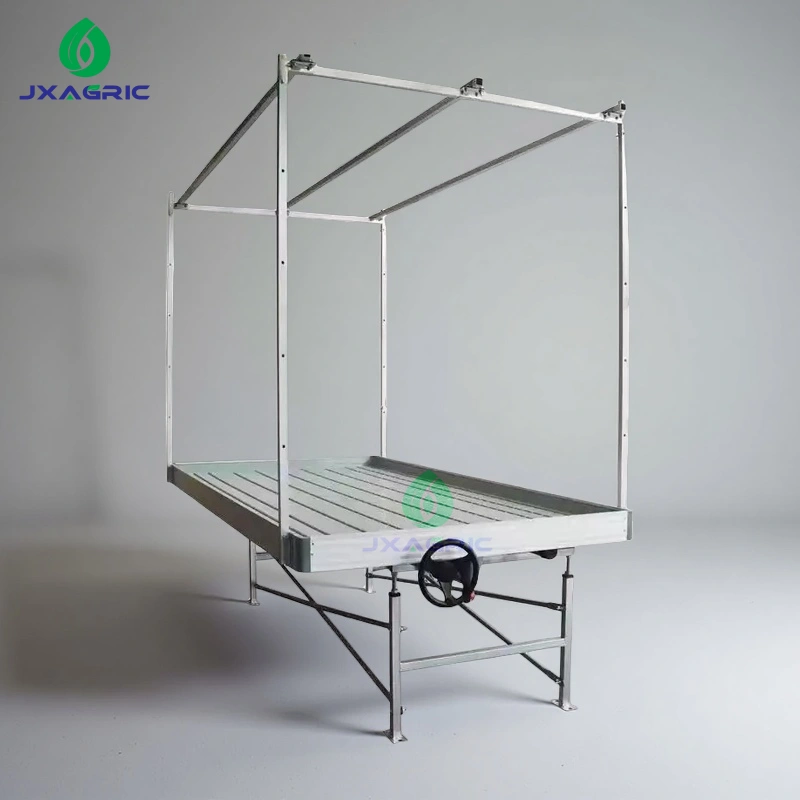
- Ebb and flow cultivation beds and supporting structures.
- Automated nutrient solution circulation systems.
- Hydroponic growing equipment and accessories.
- Greenhouse cultivation systems.
- Customized system planning and layout design.
- Technical support and equipment supply.
Whether you are planning a small commercial hydroponic farm or a larger plant factory project, JXAGRIC can help develop a suitable system based on your cultivation area, crop selection and production requirements.
Contact JXAGRIC to discuss your hydroponic project and get a customized cultivation system proposal.
Website: https://www.jxagric.com/
Related products:
Views: 0