
Plant Factory Cultivation Systems: Growing Technologies, Pest Control & LED Lighting

Plant Factory Cultivation Systems: Growing Technologies, Physical Pest Control & LED Lighting
A modern Plant Factory is more than an indoor agricultural facility. It is an integrated production environment that combines advanced cultivation technologies, specialized growing equipment, environmental control, physical pest management and supplementary lighting to support efficient crop production.
With the development of controlled environment agriculture (CEA), commercial growers are increasingly adopting soilless cultivation technologies to improve production efficiency, optimize available space and maintain consistent crop quality.
A well-designed Plant Factory can integrate Nutrient Film Technique (NFT), substrate culture, aeroponics, tidal culture and other growing methods according to crop characteristics and production requirements.
Meanwhile, physical pest control and LED grow lights help maintain suitable growing conditions, support healthy plant development and improve production consistency.
Whether you are planning a commercial greenhouse, an indoor vertical farm or a fully automated agricultural facility, understanding these technologies is essential for selecting the right equipment and designing an efficient production system.
This guide explains the main cultivation technologies, equipment configurations, pest management methods and supplementary lighting solutions used in modern agricultural facilities.
1. What Is a Plant Factory?
A Plant Factory is a controlled agricultural production facility where environmental conditions and cultivation processes are managed to support plant growth throughout the production cycle.
Unlike conventional outdoor farming, this production model uses specialized growing structures, irrigation equipment and environmental management technologies to provide plants with suitable water, nutrients, oxygen, light and temperature.
A modern Plant Factory can operate in an indoor building, greenhouse, converted industrial facility or modular container farm.
The main objectives are to:
- Increase growing capacity through vertical cultivation.
- Improve water and nutrient utilization.
- Reduce dependence on outdoor weather conditions.
- Maintain more consistent crop quality.
- Improve labor efficiency through automation.
- Support year-round vegetable and herb production.
A complete cultivation solution generally consists of two major components.
1. Cultivation Technology
Cultivation technology refers to the growing methods used to provide plants with water, nutrients and oxygen. Common methods include substrate culture, NFT hydroponics, aeroponics, tidal culture and wet culture.
2. Cultivation Equipment
Equipment includes growing channels, cultivation beds, support frames, reservoirs, pumps, irrigation pipelines, lighting fixtures and intelligent controllers.
The combination of appropriate growing technology and reliable equipment directly influences crop quality, production capacity, labor efficiency and operating costs.
For additional information about controlled environment agriculture, visit Cornell University’s Controlled Environment Agriculture Program.
2. Main Cultivation Technologies Used in a Plant Factory
Cultivation technologies have continuously evolved to improve resource utilization, growing efficiency and production stability.
Different crops have different root structures, nutrient requirements and environmental preferences. Therefore, selecting an appropriate growing method is one of the most important decisions when planning a commercial Plant Factory.
The five major soilless cultivation technologies are substrate culture, Nutrient Film Technique, aeroponics, tidal culture and wet culture.
2.1 Substrate Culture
Substrate culture is one of the most widely used soilless growing methods.
Instead of growing plants directly in soil, growers use suitable growing media to support roots and retain water and nutrients.
Common growing substrates include:
- Coco peat and coconut fiber.
- Rockwool.
- Perlite.
- Expanded clay pebbles.
- Phenolic foam and propagation sponges.
Nutrient solution is delivered through drip irrigation or other irrigation equipment, allowing plant roots to absorb the water and nutrients required for healthy development.
Main advantages of substrate culture:
- Provides physical support for plant roots.
- Allows flexible water and nutrient management.
- Suitable for crops with different root structures.
- Can be integrated with Dutch bucket systems.
- Compatible with substrate gutter cultivation.
- Supports commercial production of tomatoes, cucumbers, strawberries and peppers.
Substrate culture is particularly suitable for fruiting vegetables and crops that require stable root support.
For commercial growers, a properly designed substrate irrigation system can help improve water distribution and reduce unnecessary nutrient solution consumption.
2.2 Nutrient Film Technique (NFT)
Nutrient Film Technique is one of the most widely used hydroponic methods for commercial leafy vegetable production.
In an NFT system, a shallow layer of nutrient solution flows along the bottom of specially designed growing channels. Plant roots absorb water and nutrients while remaining partially exposed to air.
A typical NFT hydroponic system includes:
- Food-grade PVC NFT growing channels.
- Net pots and plant support components.
- Nutrient solution reservoirs.
- Water circulation pumps.
- Water supply and return pipelines.
- Nutrient solution monitoring equipment.
Main advantages of NFT cultivation:
- Efficient use of water and nutrients.
- No traditional soil required.
- Suitable for multi-layer growing structures.
- Convenient crop management and harvesting.
- Recirculating nutrient solution helps reduce water waste.
- Flexible channel lengths, hole spacing and growing configurations.
NFT is commonly used for lettuce, basil, spinach, kale and other leafy vegetables.
For commercial applications, food-grade PVC channels with light-blocking inner surfaces can help reduce algae growth and maintain a cleaner root environment.
When designing an NFT installation, growers should consider channel slope, water flow, plant spacing, pump capacity and drainage performance.
An efficient NFT layout can help commercial farms improve planting density and make better use of available production space.
2.3 Aeroponics
Aeroponics is an advanced soilless growing method in which plant roots are suspended inside an enclosed or partially enclosed growing space.
Instead of being submerged in nutrient solution or supported by conventional substrates, roots receive nutrients through fine droplets or mist produced by specialized spraying equipment.
A typical aeroponic installation includes:
- Vertical growing towers or cultivation chambers.
- Spray nozzles and misting equipment.
- Nutrient solution reservoirs.
- Water pumps and pipelines.
- Timers and automatic controllers.
Main advantages of aeroponics:
- High oxygen availability around plant roots.
- Suitable for vertical and multi-sided growing structures.
- Efficient use of limited growing space.
- Reduced dependence on conventional growing substrates.
- Flexible integration into specialized indoor agricultural facilities.
However, aeroponic installations require reliable spraying equipment and regular maintenance.
Pump failures, blocked nozzles or interruptions in nutrient delivery can quickly affect exposed roots. Therefore, backup equipment and regular system inspections are important.
Aeroponics is commonly considered for vertical towers, cylindrical growing structures and specialized space-saving agricultural applications.
2.4 Tidal Culture (Ebb and Flow Cultivation)
Tidal culture, also known as ebb and flow cultivation, imitates the natural movement of tides.
During irrigation, nutrient solution enters the cultivation bed and reaches plant roots. After a preset period, the solution drains back into the reservoir. This process repeats according to a programmed irrigation cycle.
A typical tidal cultivation system includes:
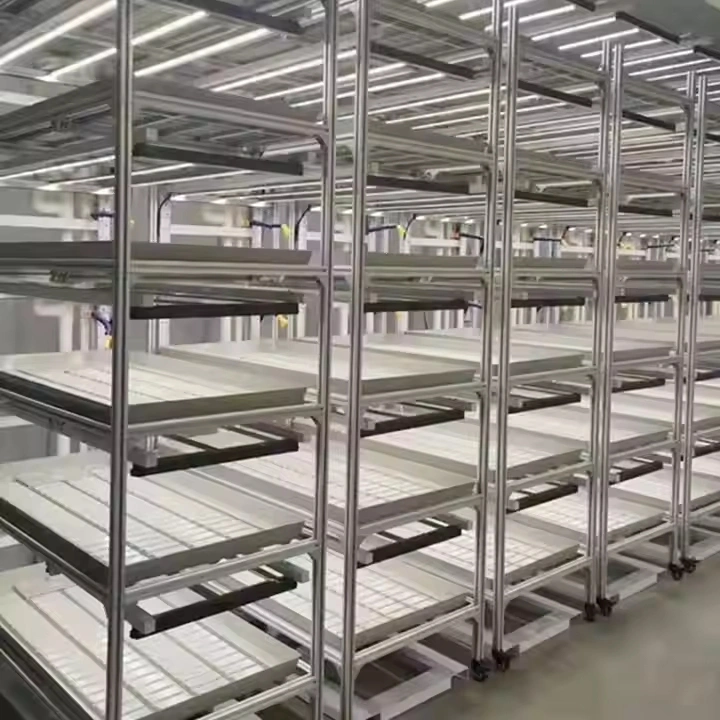
- Fixed or movable cultivation beds.
- Growing trays or cultivation boards.
- Nutrient solution reservoirs.
- Circulation pumps.
- Water supply and drainage pipelines.
- Automatic irrigation controllers.
Main advantages of tidal culture:
- Provides periodic water and nutrient delivery.
- Allows air to enter the root zone during drainage.
- Supports nutrient solution recycling.
- Can be integrated with multi-layer growing structures.
- Offers flexible irrigation management.
Tidal cultivation is suitable for leafy vegetables, herbs, seedlings and certain ornamental plants.
Properly designed systems can reduce unnecessary pump operating time. Actual energy savings depend on pump capacity, irrigation frequency, hydraulic design and operating conditions.
For commercial applications, movable ebb and flow beds can also improve the utilization of greenhouse space and simplify daily farm operations.
2.5 Wet Culture
Wet culture maintains plant roots in contact with nutrient solution under controlled growing conditions.
Depending on the design, roots may be partially or continuously exposed to nutrient solution, with appropriate oxygen supply and water circulation.
Wet culture can be integrated into specially designed vertical structures, cultivation boards and compact growing equipment.
Main advantages include:
- Direct delivery of water and dissolved nutrients.
- Reduced dependence on conventional growing substrates.
- Compatibility with selected vertical growing structures.
- Potential for automated irrigation and nutrient management.
Dissolved oxygen, water temperature and circulation must be properly managed to prevent stagnant water and support healthy root development.
Wet culture is particularly dependent on good water management and suitable system design.
2.6 Comparison of Different Cultivation Technologies
| Growing Method | Main Characteristics | Suitable Crops or Applications |
|---|---|---|
| Substrate culture | Roots supported by growing media | Tomatoes, strawberries, cucumbers and peppers |
| NFT hydroponics | Thin nutrient solution flows through channels | Lettuce, spinach and basil |
| Aeroponics | Roots receive nutrient mist | Vertical towers and indoor farms |
| Tidal culture | Periodic flooding and drainage | Leafy greens, seedlings and herbs |
| Wet culture | Roots remain in contact with nutrient solution | Specialized vertical growing systems |
The selection of a suitable cultivation method should consider crop varieties, growing structures, investment budgets, labor requirements and local environmental conditions.
There is no universal solution for every commercial farm. The right combination of cultivation technology and equipment should be determined by actual production requirements.
3. How to Choose the Right Cultivation System for Vertical Farming
Vertical farming maximizes growing capacity by arranging plants in multiple layers or vertical structures.
For a commercial Plant Factory, the relationship between cultivation structure, root environment and crop characteristics must be evaluated before purchasing equipment.
3.1 Selection Based on Growing Structures
Plane Multi-Layer Cultivation
Multi-layer cultivation beds and growing channels are commonly used for NFT and tidal culture.
They are suitable for leafy vegetables and herbs and help maximize production area.
Cylindrical and Tower-Type Cultivation
Vertical hydroponic towers and multi-sided structures can use aeroponic or specially designed nutrient delivery systems.
They are particularly suitable for compact leafy vegetable production and applications where floor space is limited.
Single-Sided and Double-Sided Vertical Cultivation
These structures can adopt specially designed wet culture systems, depending on root support, irrigation and oxygen requirements.
Curtain-Wall Cultivation
Vertical green walls and curtain-style structures may use substrate culture, tidal irrigation or wet culture according to crop characteristics and structural design.
3.2 Selection Based on Crop Varieties
Different crops have different root structures, nutrient requirements and growth characteristics.
| Crop Type | Recommended Growing Systems |
|---|---|
| Lettuce and leafy vegetables | NFT channels, multi-layer beds, vertical towers |
| Basil and culinary herbs | NFT, substrate culture, vertical systems |
| Tomatoes and cucumbers | Dutch bucket systems, substrate gutters |
| Strawberries | Substrate gutter systems, specialized hydroponics |
| Medicinal plants | Multi-layer substrate cultivation, depending on species |
| Mushrooms | Multi-layer growing racks and suitable bag cultivation |
For special crops, the growing structure and irrigation technology should be adjusted according to plant size, root development, light requirements and production objectives.
A well-designed Plant Factory layout should also consider planting density, maintenance access, lighting distribution and the daily workflow of farm operators.
The most technologically advanced solution is not necessarily the most economical choice. Commercial projects should balance production performance, investment costs and long-term operating expenses.
4. Plant Factory Equipment and System Components
Equipment provides the physical foundation for commercial growing facilities.
High-quality equipment is essential because structural stability, material durability and irrigation performance directly influence long-term operating efficiency.
A complete Plant Factory equipment configuration should provide reliable structural support, uniform water distribution, convenient operation and easy maintenance.
4.1 Single-Sided and Double-Sided Mini Plant Factory Equipment
Mini growing equipment is designed for compact vertical cultivation applications.
A typical structure includes three major components.
1. Support Frame
The frame consists of columns, connecting structures, reservoir supports and movable rollers where required.
It provides structural stability and supports cultivation beds and nutrient solution reservoirs.
2. Cultivation Beds
Cultivation beds consist of supporting frames, fixing components and cultivation boards.
They support plants and provide a suitable environment for water, nutrient and oxygen delivery to the root zone.
3. Nutrient Solution Reservoir
The reservoir stores nutrient solution and supplies it through circulation pumps and pipelines.
Excess solution can return to the reservoir for recycling.
Additional equipment may include:
- Water supply and drainage pipes.
- Circulation pumps.
- Automatic irrigation controllers.
- LED supplementary lights.
- Electrical control systems.
- Environmental monitoring equipment.
When selecting equipment, project developers should consider structural strength, material durability, assembly convenience, maintenance access and compatibility with the cultivation method.
4.2 Composite Mini Plant Factory Equipment
Composite equipment combines multiple single-sided or double-sided cultivation units into one integrated structure.
For example, two or three individual units can be connected to expand the total growing area.
Depending on the design, the combined structure may share nutrient solution reservoirs, circulation pumps and intelligent controllers.
Key benefits include:
- Expanding the growing area.
- Improving available floor-space utilization.
- Reducing duplicated equipment.
- Simplifying centralized nutrient solution management.
- Supporting modular expansion for commercial projects.
The final configuration should be determined by growing area, crop requirements, hydraulic design and expected production capacity.
For large-scale projects, modular equipment can make future expansion and maintenance more convenient.
5. Main Characteristics of Modern Plant Factories
Modern agricultural facilities combine cultivation equipment, environmental management and digital technologies to improve production consistency.
The development of the Plant Factory industry is closely related to several important technological trends.
Facility-Based Production
Plants grow in controlled greenhouse or indoor environments rather than depending entirely on outdoor weather conditions.
Vertical Cultivation
Multi-layer structures increase planting density and improve space utilization.
Resource Efficiency
Water and nutrient solutions can be circulated and reused, reducing unnecessary resource consumption.
Digital Management
Sensors and intelligent controllers monitor temperature, humidity, pH, electrical conductivity (EC) and other growing parameters.
Automated Operation
Irrigation, lighting, ventilation and other processes can be programmed or automatically controlled.
Integrated Technologies
Hydroponics, LED lighting, pest management and environmental control work together to create a more stable growing environment.
Digital management makes operations more efficient by connecting environmental sensors, irrigation controllers, lighting equipment and production monitoring systems.
6. Physical Pest Control for Plants
Pest and disease management is essential for commercial crop production.
Inappropriate pesticide application can create residue concerns, environmental pollution and food safety risks.
In controlled growing environments, physical pest management provides additional methods for controlling certain microorganisms and insects while reducing dependence on chemical treatments.
Maintaining proper sanitation inside a Plant Factory helps reduce potential pest and disease risks while supporting safer and more consistent crop production.
6.1 Main Physical Pest Control Technologies
1. Ozone Treatment
Ozone is a strong oxidizing agent used in appropriately designed water treatment and sanitation applications.
It may help reduce certain microorganisms in water and on suitable surfaces.
However, ozone concentrations must be carefully controlled because excessive exposure can damage plants and create health risks for workers.
2. UV Sterilization
UV-C treatment can inactivate certain microorganisms in water, air and on exposed surfaces.
It is used in some agricultural sanitation and water treatment applications.
Its effectiveness depends on UV intensity, exposure time, water clarity and the target microorganism.
Suitable shielding and safety controls are essential to prevent harmful exposure to workers and plants.
3. Magnetized Water Treatment
Magnetic water treatment systems expose water to magnetic fields before it enters an irrigation system.
Some manufacturers promote these systems for improving water characteristics. However, evidence for consistent agricultural benefits remains limited.
It should not replace proven water treatment or nutrient management practices.
4. Functional Water Treatment
Certain functional water technologies, including electrolyzed water, can be used for agricultural sanitation and microbial management.
Performance depends on active compounds, concentration, pH, contact time and application methods.
5. High-Voltage Electrostatic Pest Control
Electrostatic technologies are used in certain agricultural applications to improve treatment droplet distribution and manage flying insects.
Effectiveness depends on equipment design, operating conditions and target pests.
6.2 Benefits of Physical Pest Management
When correctly selected and applied, physical pest management can:
- Reduce dependence on conventional chemical pesticides.
- Support integrated pest management (IPM).
- Improve sanitation in controlled growing environments.
- Help manage certain microbial risks.
- Support cleaner agricultural production.
- Complement biological and preventive pest management methods.
Physical treatments should not be considered a universal replacement for all chemical or biological methods.
An integrated pest management program remains the most reliable approach.
For additional agricultural pest management information, refer to University of California Integrated Pest Management.
7. LED Supplementary Lighting for Plant Factories
Light is one of the most important environmental factors affecting plant growth.
Together with water, nutrients, carbon dioxide and temperature, light influences photosynthesis, plant development, crop yield and product quality.
Natural sunlight is the primary light source in many greenhouse facilities.
However, insufficient sunlight during winter, cloudy weather or short daylight periods can limit crop development.
Indoor vertical farms often depend on artificial lighting because natural sunlight may be unavailable or insufficient.
A properly designed LED lighting system provides suitable light intensity and spectrum according to crop requirements.
In an indoor Plant Factory, artificial lighting may serve as the primary energy source for photosynthesis throughout the growing cycle.
7.1 Why Is Supplementary Lighting Important?
During photosynthesis, plants absorb light energy and use it to convert carbon dioxide and water into carbohydrates.
These carbohydrates support:
- Root development.
- Leaf growth.
- Flowering.
- Fruit formation.
- Biomass accumulation.
When natural light is insufficient, photosynthesis may become limited, reducing crop growth and production efficiency.
LED grow lights can supplement sunlight in greenhouses or serve as the primary light source in fully indoor growing facilities.
Main benefits include:
- Improved light availability during low-light periods.
- More consistent crop production.
- Flexible light spectrum selection.
- Potentially improved energy efficiency compared with conventional lighting.
- Flexible installation in multi-layer racks and vertical growing structures.
Research at Cornell University discusses resource optimization and energy-efficient lighting approaches in controlled environment agriculture.
7.2 Three Important Lighting Parameters
1. Light Intensity
Light intensity describes the amount of light received by plants.
Human-oriented illuminance is measured in lux (lx).
However, lux is not the best measurement for evaluating photosynthetic lighting because it is weighted according to human visual sensitivity.
For horticultural applications, Photosynthetic Photon Flux Density (PPFD), measured in μmol/m²/s, is more useful.
2. Light Compensation Point
The light compensation point is the light intensity at which photosynthesis and respiration are approximately balanced.
Below this point, net carbon gain becomes negative under the measured conditions.
The value varies according to plant species, age, temperature and environmental conditions.
3. Light Saturation Point
The light saturation point is the approximate intensity above which additional light produces little or no significant increase in photosynthetic rate under specific conditions.
Excessive light can also cause photoinhibition and plant stress.
Therefore, lighting intensity should be adjusted according to crop characteristics rather than using one universal lux value.
7.3 Understanding PPFD and Daily Light Integral (DLI)
For commercial indoor farming and greenhouse production, PPFD and Daily Light Integral are particularly important.
PPFD (Photosynthetic Photon Flux Density) measures instantaneous photosynthetic light intensity.
DLI (Daily Light Integral) measures the total photosynthetically active light received by plants over a 24-hour period. It is expressed in mol/m²/day.
For example, if a growing area receives a constant PPFD of 200 μmol/m²/s for 16 hours:
DLI = 200 × 16 × 3,600 ÷ 1,000,000
DLI = 11.52 mol/m²/day
Understanding these parameters helps growers select suitable fixtures, determine lighting duration and manage crop-specific light requirements.
For additional technical guidance, refer to Purdue University’s guide to measuring Daily Light Integral.
7.4 LED Grow Light Spectrum
Different wavelengths influence plant growth and development in different ways.
Blue Light (Approximately 400–500 nm)
Blue light contributes to leaf development, stomatal regulation and plant morphology.
Red Light (Approximately 600–700 nm)
Red light is strongly absorbed by chlorophyll and contributes significantly to photosynthesis. It also influences flowering and other developmental processes.
Green Light (Approximately 500–600 nm)
Green light can penetrate deeper into plant canopies and contribute to photosynthesis in lower leaves.
Far-Red Light (Approximately 700–750 nm)
Far-red light influences plant morphology, shade responses and flowering in certain species.
The appropriate LED spectrum should be selected according to crop variety, growing stage and production objectives.
7.5 Integrating LED Lighting with Greenhouses and Indoor Farms
A complete lighting solution should work together with the greenhouse structure and environmental control equipment.
Greenhouse Applications
Greenhouses use natural sunlight as the primary light source.
LED supplementary lighting compensates for low-light conditions, particularly during winter and cloudy periods.
Greenhouse structures may use agricultural films, polycarbonate panels or glass.
Shading systems, ventilation fans and evaporative cooling equipment help manage excessive solar radiation and temperature.
Indoor Vertical Farming Applications
Indoor facilities depend heavily on artificial lighting.
LED fixtures can be installed above individual cultivation layers to provide controlled lighting for lettuce, herbs and other crops.
The lighting system should be coordinated with temperature control, air circulation, humidity management and irrigation.
Automated Lighting Management
Intelligent controllers can adjust lighting schedules according to crop requirements, growing stages and available natural sunlight.
This helps manage electricity consumption while maintaining suitable growing conditions.
For a commercial Plant Factory, lighting design should consider PPFD distribution, DLI requirements, fixture efficiency, installation height and operating costs.
8. How to Build an Efficient Commercial Plant Factory
Building a commercial growing facility requires an integrated approach rather than simply purchasing individual pieces of equipment.
The following factors should be considered during project planning.
Step 1: Identify Crop Varieties
Determine whether the project will grow lettuce, herbs, strawberries, tomatoes or other crops.
Different varieties require different growing structures and root environments.
Step 2: Determine the Growing Area
Calculate available floor space, ceiling height, planting density and the number of cultivation layers.
Step 3: Select the Cultivation Technology
Choose between NFT, substrate culture, aeroponics, tidal culture and other suitable methods according to crop requirements and project conditions.
Step 4: Configure the Equipment
Select growing channels, cultivation beds, support frames, water reservoirs, pumps, pipelines and essential accessories.
Step 5: Design the Lighting System
Evaluate natural light availability and determine the required LED intensity, spectrum, installation position and operating schedule.
Step 6: Plan Environmental Control and Pest Management
Integrate temperature, humidity, ventilation, water quality and pest management into the overall production plan.
Step 7: Test and Optimize the Installation
Before commercial production, test water circulation, nutrient distribution, lighting performance and environmental controls.
Adjust the configuration according to actual crop performance.
Before investing in a Plant Factory, commercial growers should also evaluate electricity consumption, water requirements, labor costs, equipment maintenance and expected market demand.
A properly planned facility can improve space utilization, resource management and production consistency while supporting long-term commercial operation.
9. Frequently Asked Questions About Plant Factories
Q1: What is the best cultivation method for a Plant Factory?
There is no single best solution for every project.
NFT is widely used for leafy vegetables, substrate culture is suitable for many fruiting crops, aeroponics is suitable for specialized vertical structures, and tidal culture is useful for applications requiring periodic irrigation and drainage.
The right choice depends on crop varieties, available space, investment budget and production targets.
Q2: What is the difference between NFT and aeroponics?
NFT delivers a thin film of nutrient solution along the bottom of growing channels, allowing roots to absorb water and nutrients.
Aeroponics suspends roots in an enclosed space and delivers nutrient solution through spraying or misting equipment.
NFT is commonly used for leafy vegetable production, while aeroponics is often integrated into vertical towers and specialized growing structures.
Q3: Is a Plant Factory suitable for commercial farming?
Yes. Commercial growers use hydroponic and other soilless growing technologies to produce vegetables and herbs in controlled environments.
Commercial feasibility depends on construction costs, energy consumption, labor costs, crop prices, market demand and operating efficiency.
Q4: Why are LED grow lights important in vertical farming?
Vertical farms often have limited access to natural sunlight, particularly in multi-layer indoor facilities.
LED fixtures provide controlled light intensity and spectrum, helping maintain suitable photosynthetic conditions and support consistent crop production.
Q5: What is the difference between supplementary lighting and full artificial lighting?
Supplementary lighting adds artificial light to natural sunlight when sunlight is insufficient.
Full artificial lighting provides the primary light source in indoor growing environments where natural sunlight is unavailable or inadequate.
Q6: Can physical pest control replace chemical pesticides?
Physical methods can reduce dependence on certain chemical treatments, but they cannot eliminate every pest or plant disease.
A comprehensive integrated pest management strategy should combine preventive sanitation, environmental monitoring, biological control and appropriate physical or chemical treatments when necessary.
Q7: How do I choose a reliable hydroponic equipment manufacturer?
Consider product quality, material specifications, system design experience, customization capabilities, manufacturing capacity, technical support and after-sales service.
An experienced supplier should recommend suitable equipment according to crop varieties, growing area and project requirements.
10. Conclusion: Integrated Technologies Shape the Future of Plant Factories
Modern agricultural production increasingly depends on the integration of efficient growing technologies, reliable equipment, environmental control, physical pest management and intelligent lighting.
From NFT hydroponics and substrate culture to aeroponics and tidal cultivation, each method offers different advantages for specific crops and production structures.
Physical pest management and LED supplementary lighting further help create a stable and manageable environment for commercial greenhouses and indoor vertical farms.
A successful Plant Factory is not simply a collection of growing equipment. It is an integrated production solution designed around crop requirements, resource efficiency and long-term operating performance.
Looking for a Customized Plant Factory Solution?
Jiang Xin Technology Co., Ltd. (JXAGRIC) specializes in hydroponic systems, agricultural equipment and customized soilless cultivation solutions.
Our product range includes:
- NFT hydroponic growing systems.
- Vertical hydroponic tower systems.
- Dutch bucket cultivation systems.
- Strawberry substrate gutter systems.
- Ebb and flow cultivation beds.
- Greenhouse growing equipment.
- Hydroponic accessories and growing materials.
Whether you are planning a new commercial farm or upgrading an existing growing facility, our team can help you select suitable equipment and develop a customized cultivation solution.
Contact JXAGRIC to discuss your project and request a customized hydroponic system proposal.
Website: https://www.jxagric.com/
Related products:
Views: 0